Baby’s First Plastics

Theme: Are the most vulnerable stages of life protected from environmental pollution?

Plastic pollution has become a pervasive environmental and health concern, infiltrating ecosystems, food systems, and the human body. As plastics degrade into microplastics, they circulate through food and water sources and ultimately cycle back to humans. Researchers have found microplastics within reproductive organs, the placenta, breast milk, and even meconium, an infant’s first feces, indicating that exposure begins before birth. Even after birth, infants continue to consume microplastics through food, water, breast milk, and objects placed in their mouths. The consumption and bioaccumulation of microplastics are alarming as they potentially affect human health, including inflammation, neurological development, cancer, metabolic disorders, and more.

This work is informed by environmental health research on microplastic exposure beginning in early life and the bioaccumulation of plastics through everyday ingestion pathways.

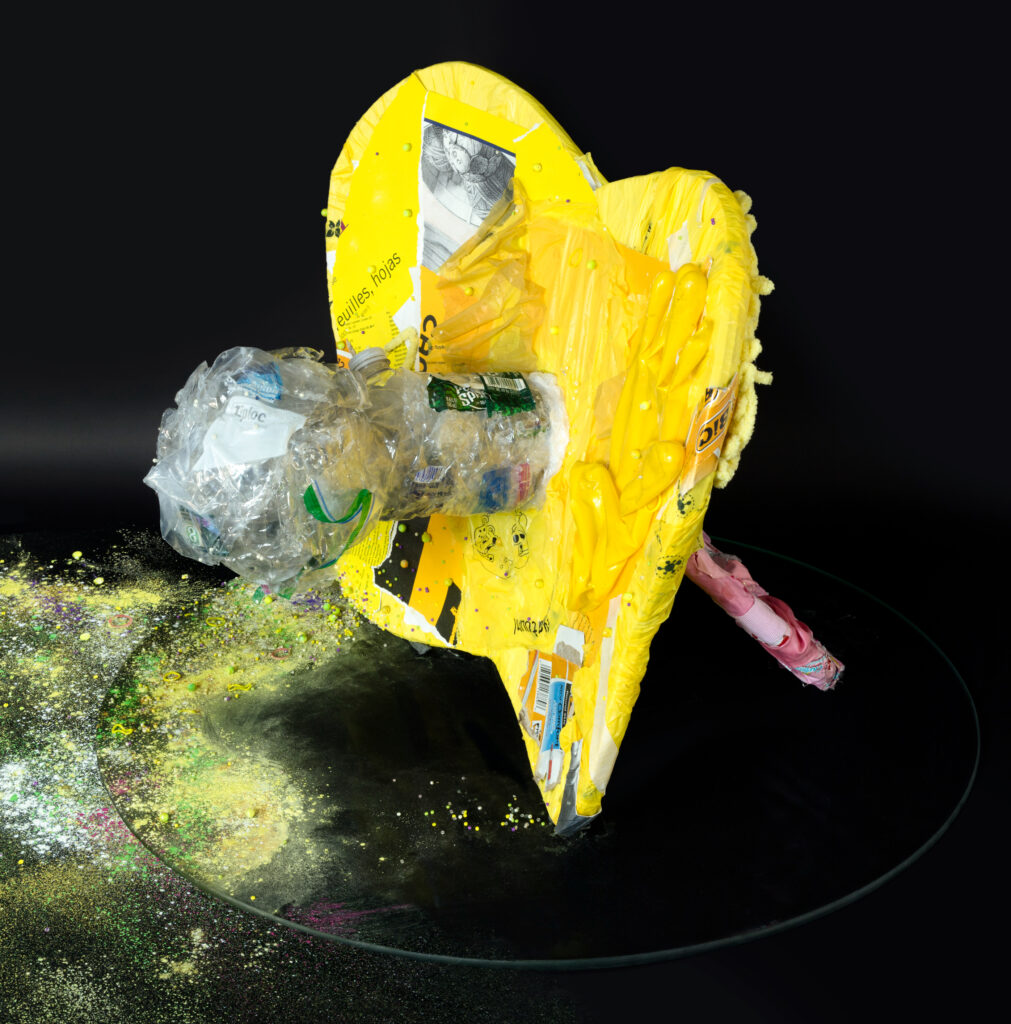
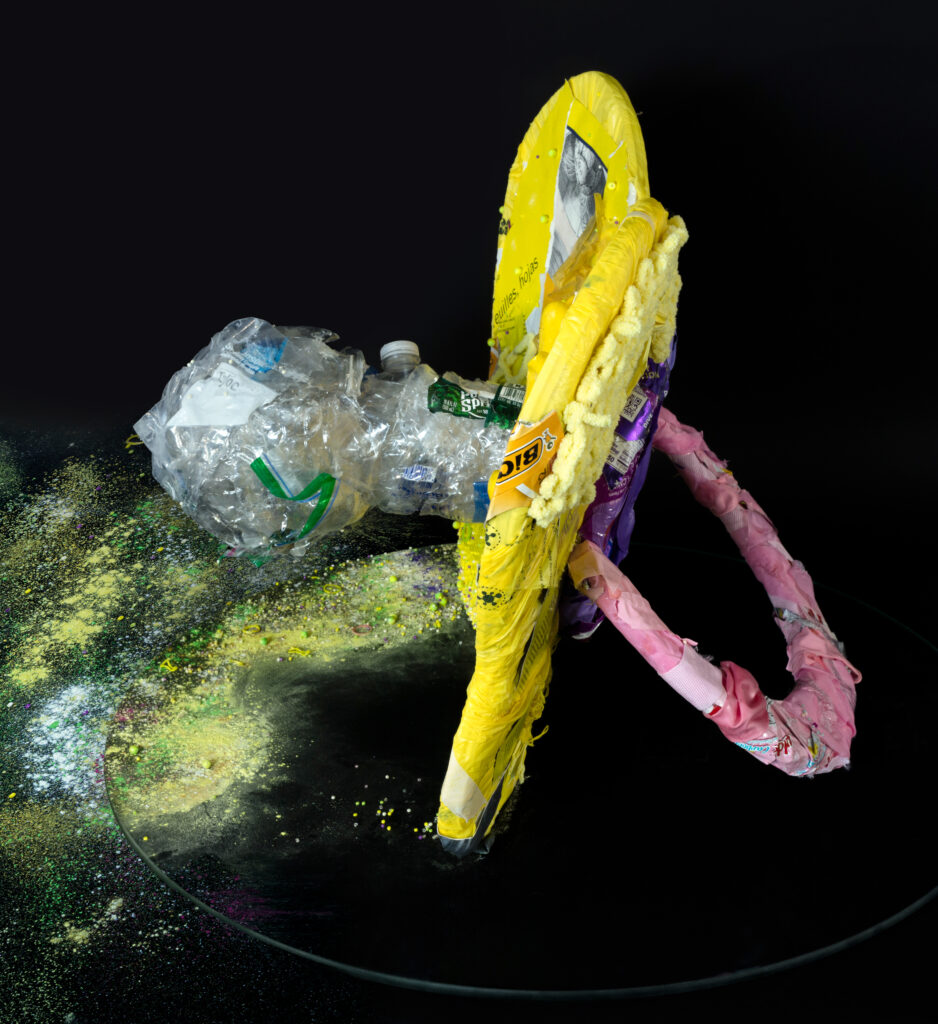
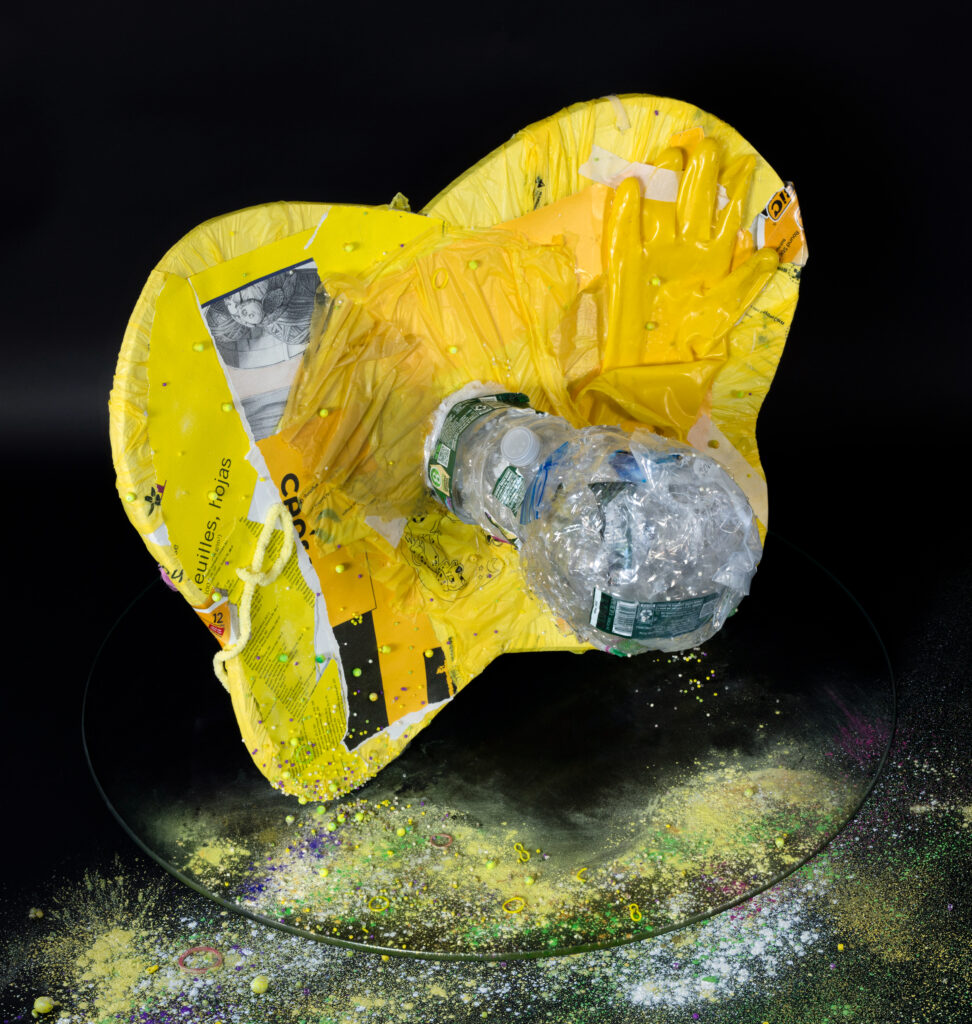
The mixed-media work depicts a baby pacifier made from various plastic and trash items, including food packaging and containers, a straw, beads, dog poop bags, plastic bottles, Ziplock bags, tape, school supplies, synthetic fibers, and more. I intentionally included plastics that are common in daily life to emphasize that these contaminants are deeply integrated into our daily lives. Thus, the pacifier, which is associated with safety and comfort for babies, becomes a symbol of how babies are fed with plastic. The nipple of the pacifier is made exclusively from plastic materials, representing how babies literally suck on plastic from birth. Surrounding the pacifier is scattered powder and small beads that refer to the degradation of larger plastic waste into microplastics that disperse into the environment. 

I constructed the pacifier’s form using foam board, which allowed me to carve and mark the surface to mimic the curvature of an actual pacifier. I used various adhesives, such as hot glue, super glue, and tape, to bind plastic materials. For the nipple part, primarily plastic bottles, Ziploc bags, and tape were molded into the shape using a heat gun and glue gun. Finally, ResinCrete powder and mica powder were used to imitate the texture of microplastics.

Through Baby’s First Plastic, I hope to expose the unsettling reality of plastic not just as an environmental crisis but as a direct threat to human health. By transforming a symbol of infancy into that of contamination, this work questions whether we are ever truly safe, even from the moment we are born.


Referance

Smithsonian Magazine. (2021). Baby poo has ten times more microplastics than adult feces.
https://www.smithsonianmag.com/smart-news/study-shows-infant-poop-is-riddled-with-microplastics-180978770/

MDPI. (2024). An overview of the possible exposure of infants to microplastics. Life, 14(3), 371.
https://www.mdpi.com/2075-1729/14/3/371

ScienceDirect. (2023). [Article on microplastic exposure and health effects]. Environment International.
https://www.sciencedirect.com/science/article/pii/S016041202300569X