Forbidden Feast- A Meal Covered in Plastic
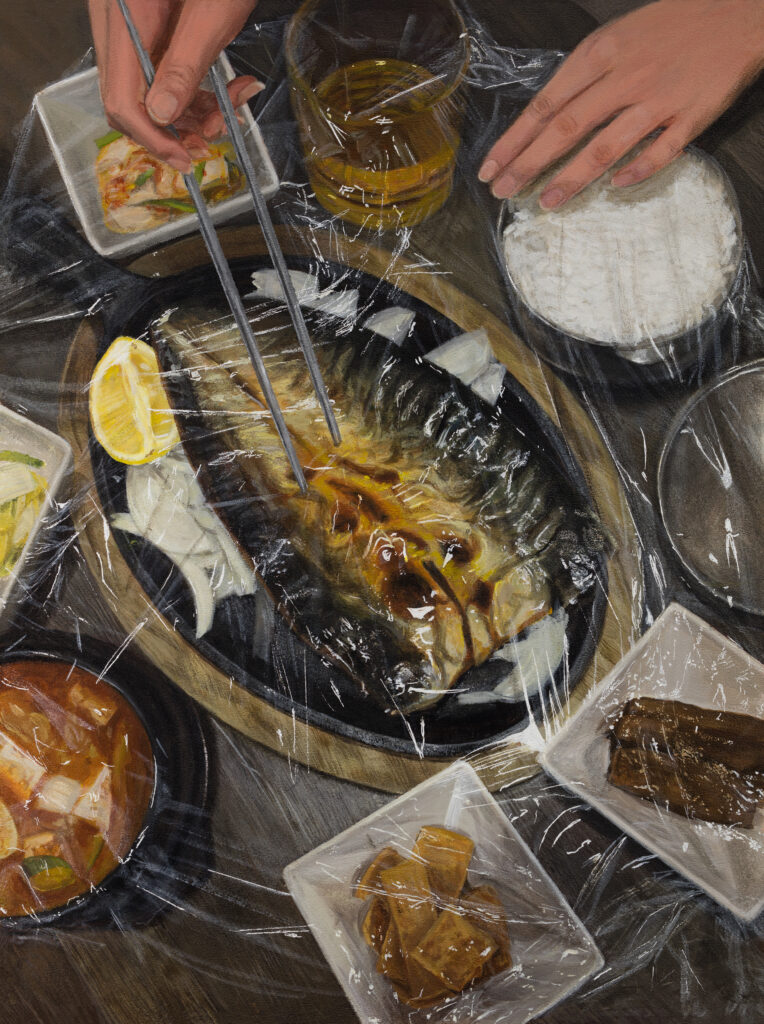
Forbidden Feast

National Silver Medal,
Scholastic Art & Writing 2026

Honorarium Award (Group winner; $1000)
Creative Change Makers, New Jersey State Teen Arts Festival  | 2026

1st Place Winner ($500)
Bruce Museum iCreate Competition | 2026
Invited iCreate Exhibition at the Bruice Museum

Happy Village Award
Korea Daily Student Art & Video Contest 2026


Theme: How does the accumulation of pollution in ecosystems return to our table? Where does pollution accumulated in ecosystems ultimately end?

The Hackensack River in New Jersey was designated as a Superfund Site due to heavy contamination with strict advisories against the consumption of marine life caught. This local reality reflects a broader crisis of water contamination. In the ocean, plastic pollution has been an emerging concern as plastics break down into microplastics and contaminate the ocean. These particles move through the marine food chain and eventually reach humans through the consumption of seafood, especially fish. As a result, foods that appear clean and healthy often contain invisible traces of plastic, which we unknowingly consume. Recent studies suggest that microplastics may contribute to inflammation, cellular damage, oxidative stress, disruptions to the gut microbiome, cardiovascular and metabolic disorders, reproductive issues, and even cancer.

This work is informed by environmental health research on microplastic exposure through seafood consumption and bioaccumulation in the marine food chain. This painting depicts a common traditional Korean meal centered around mackerel, a fish often called “the ocean’s barley” in Korea for its nutritional value and health benefits. Plastic wrap tightly covers the meal, while a pair of chopsticks struggles to grab the fish beneath the suffocating layer. The scene symbolizes how plastic pollution has even infiltrated our food, preventing us from eating truly healthy, clean meals. 

After developing a concept of a meal covered in plastic wrap, I went to a Korean restaurant with plastic wrap, tape, and a camera, and ordered a full meal to stage and photograph it. These photographs became my primary reference for this piece.

I used acrylic paint because of its flexibility to easily revise, layer, and build strong contrasts. This was especially important in balancing the warmth of the food with a layer of plastic. I also used a white gel pen to depict the highlights of the plastic wrap, which was essential to capture the tension of the plastic. 

Through this work, I hope to expose the unsettling reality of plastic not just as an environmental crisis but as a direct threat to human health. The meal covered in plastic reflects the “healthy” food we eat every day, yet contaminated.

Referance

ScienceDirect. (2025). Bioaccumulation and trophic transfer of microplastics in oceanic food webs. Marine Pollution Bulletin.
https://www.sciencedirect.com/science/article/abs/pii/S0025326X25015899 MDPI. (2020).

A detailed review study on potential effects of microplastics and additives of concern on human health. International Journal of Environmental Research and Public Health, 17(4), 1212.
https://www.mdpi.com/1660-4601/17/4/1212